Startup Decision Simulation
Startup Decision Simulation turns one founder or learner decision into a practical activity with constraints, feedback, debrief prompts and credible next actions.
Summary
Use this when educators, founders and startup learners need repeated rounds, changing signals and a clear debrief rather than a one-shot discussion.
Startup Decision Simulation turns a broad learning idea into one usable session: a role, a hard choice, a feedback signal and a debrief that points to a simulation plan with clear rounds and debrief anchors. The activity should make judgment visible: learners commit under a limit, meet a signal, explain their reasoning and decide what they would test or change next.
Keep the first run deliberately small. One role, one tradeoff and one clear feedback moment will teach more than a crowded board full of mechanics that nobody can explain afterward.
Why This Guide Matters
This guide matters because entrepreneurship education often asks people to discuss uncertainty without letting them feel it. A well-run activity gives that uncertainty a small, bounded shape. Learners make a choice, see a consequence and then talk about the thinking behind it.
The central decision is to show how startup choices stack over time. That decision is the spine of the session. If it is vague, the cards, prompts, scores and questions all become harder to defend.
The constraint should feel like round length, variables, feedback timing and learner overload. That keeps the exercise close to founder reality without pretending that a classroom result predicts real market behavior.
The outcome should be modest and useful: a simulation plan with clear rounds and debrief anchors. That is enough. A game does not need to prove someone is a founder. It needs to create a sharper next move.
Numbers And Signals
The EntreComp framework is a useful reference because it treats entrepreneurship as value creation through ideas, resources and action. The systematic review on experiential entrepreneurship learning supports the basic idea here: action needs reflection before it becomes learning.
The GEM 2025/2026 Global Report frames the current founder environment as active but uneven: more people are trying to start, while durable progress still depends on support systems, market evidence and better judgment under uncertainty. The Wharton Startup Game shows why early-company simulations often need roles, negotiation and competing incentives.
Startup Wars is a useful market reference for how student startup simulations present decisions, feedback and virtual business progress. Effectuation gives a strong lens for founder decisions under uncertainty, especially when learners cannot wait for perfect information.
Wharton’s Startup Game and classroom simulations such as BUILD FamBiz show the value of roles, rounds and changing incentives. The lesson gets stronger when early choices affect later options.
The numbers in a simulation do not need to predict reality. They need to create a believable feedback loop: cost changes, customer interest moves, time runs down and teams have to revise their thinking.
Session Flow
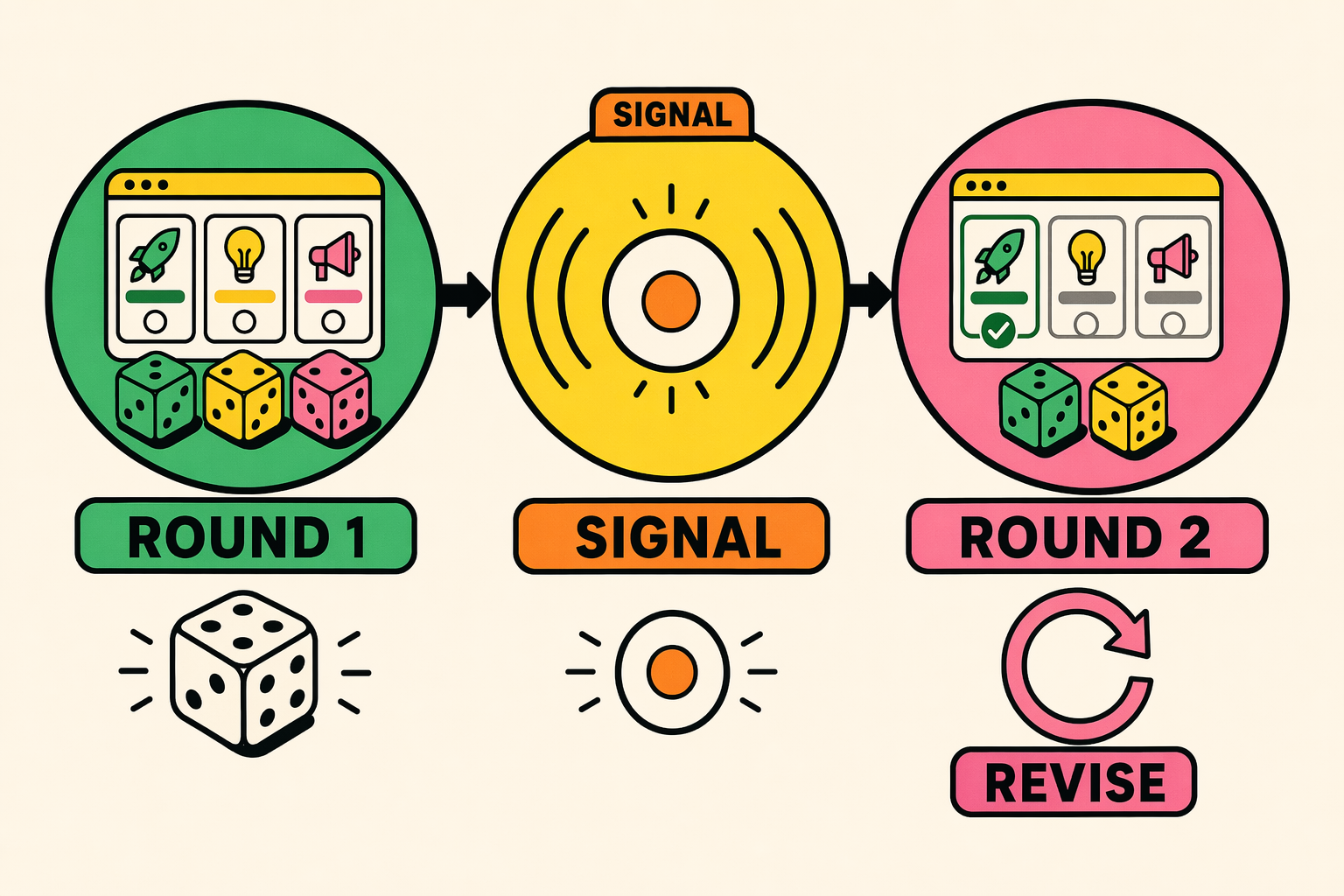
Run three short rounds. In round one, learners choose a customer segment. In round two, the market signal changes. In round three, time runs out. The debrief compares the first decision with the final one and asks what changed the team’s mind.
Use a tight sequence: frame the role, reveal the constraint, let the team choose, show how an early choice changes a later option, then ask what should happen next. The activity can be playful, but the close should be serious. The learning comes from the conversation after the choice.
The working asset can be a round map. Keep it visible. Learners should be able to point to the choice, the signal and the next action. If they cannot see those three parts, the exercise needs fewer moving pieces.
For a simulation guide, the highest-value moment is usually the second choice. The first choice shows instinct. The second choice shows whether learners used feedback. Build the run so that revision is possible.
- Run three short rounds instead of one long round.
- Let round-one choices limit round-two options.
- Show only the signal learners need for the next decision.
- Keep the dashboard readable: no more than four moving variables.
- Pause after the final round and compare first assumptions with final choices.
- Ask what evidence would change the decision outside the room.
Design Pattern
Design from the debrief backward. Start by writing the question learners should be able to answer at the end. Then design the choice that creates evidence for that question. This keeps the activity from drifting into decoration.
Four parts have to work together: a role that gives responsibility, a tradeoff that creates tension, a signal that changes the story and a reflection step that names the next move. If one part is missing, the activity may still be fun, but it will be harder to teach from.
Use a small score only when it helps learners notice something they would otherwise miss. A score should never become the whole lesson. It should point back to evidence, decisions and revision.
The language should sound like the room you are teaching. A high school version needs concrete words and visible choices. A founder version can carry more ambiguity. A remote version needs shorter rounds and clearer handoffs.
Who is making the decision and what are they responsible for?
What can they not do at the same time?
What changes after they commit?
What should they understand or try next?
Facilitation Notes
Introduce the activity in plain language. Tell learners what kind of decision they are practicing, not every lesson you hope they learn. Too much explanation before play can flatten the moment when assumptions become visible.
During the activity, watch for hesitation, overconfidence, silence and quick agreement. Those moments often show the real teaching point. A team that chooses too fast may be avoiding uncertainty. A team that debates every detail may need a stronger constraint.
After play, slow the room down. Ask what changed, what evidence mattered and what the learners would do with real customers, money, time or teammates. That is where the activity becomes startup education instead of entertainment.
Do not rescue the group too early. If the prompt is clear and the stakes are contained, a little discomfort is useful. The facilitator’s job is to keep the tension productive, not to remove every hard choice.
Assessment And Transfer
Assess the reasoning, not only the outcome. A team can choose the weaker option and still learn well if it names the assumption, responds to feedback and states a sharper next action. A team can win the activity and still miss the lesson if it cannot explain the evidence.
Good assessment looks for four signals: the learner can name the decision, explain the constraint, interpret the feedback and connect the result to action outside the activity. Those signals are more useful than a single score.
Transfer matters because entrepreneurship learning has to leave the room. The final question should send learners toward a customer interview, a pricing check, a pitch revision, a team conversation, a budget cut or another real-world next step.
A useful transfer artifact is short: one assumption, one signal, one next action and one owner. If learners need ten minutes to explain what they will do next, the close is probably too vague.
Mistakes To Avoid
The common mistake is making numbers look more precise than the lesson allows. Another mistake is adding too many variables before learners understand the first choice. Complexity can feel impressive, but it often hides the lesson.
A second risk is weak feedback. If learners only hear that they won or lost, they may remember the emotion and miss the reasoning. Feedback should explain what changed and why the choice mattered.
A third risk is overclaiming. A well-run session can reveal assumptions, rehearse judgment and prepare a better next move. It cannot prove demand, guarantee skill or replace real startup evidence.
For any session, do not let theme carry the teaching. The activity can look playful, but the design has to survive a simple question: what decision did learners practice?
Related Guides
Pair this with Online Startup Simulator vs Classroom Game and Serious Games for Entrepreneurship Education. Together, these resources help you choose the format, design the activity and close with a useful debrief.
Next, compare this topic with the related guides below. Pick the one that matches the decision your learners need to practice next.
- Online Startup Simulator vs Classroom Game
- Serious Games for Entrepreneurship Education
- Startup Simulation Game Guide
- How to Choose an Entrepreneurship Game
- Startup Game Lesson Planner
- Game-Based Entrepreneurship Education
FAQ
What should I build first?
Start with three short rounds. Early choices should shape later options so learners can see why timing and evidence matter.
Who should use this simulation guide?
Use it with educators, founders and startup learners when people need to practice judgment rather than listen to another explanation.
What should learners practice first?
Start with one decision: show how startup choices stack over time. That keeps the session narrow enough to run and clear enough to discuss.
How long should the activity take?
A short version can take 20 to 30 minutes. A deeper version can take a workshop block if the group needs repeated rounds and peer feedback.
What should the facilitator prepare?
Prepare the role, decision prompt, constraint, feedback rule and closing questions before adding scoring or materials.
What makes it feel like a game?
A game needs a role, a choice, a limit, feedback and a visible end state. Points are optional. The decision is not.
What is the safest first version?
Use one scenario, one choice, one feedback event and five debrief questions. Add more only after the first version teaches the right lesson.
How do I adapt it for beginners?
Use plain language, fewer variables and visible feedback. Beginners need a clean path from choice to consequence before ambiguity increases.
How do I adapt it for founders?
Use a real assumption, current constraint and a next action they can take after the session.
What should I avoid?
Avoid making numbers look more precise than the lesson allows. Also avoid claiming the activity proves demand, sales ability or founder readiness.
Can this work without software?
Yes. Many entrepreneurship games work with paper, cards, whiteboards and live facilitation. Software helps when repeated rounds or automated feedback matter.
When is an online simulation better?
Use an online simulation when the learning job needs changing variables, several rounds or scoring that would be hard to manage by hand.
When is a worksheet better?
Use a worksheet when the goal is to make thinking visible quickly and the debrief matters more than the scoring system.
How should feedback work?
Feedback should show what changed after the choice: cost, time, customer reaction, team tension, evidence quality or confidence.
What should the debrief ask?
Ask what learners assumed, what evidence changed, what they ignored and what they would test next outside the activity.
How do I keep it credible?
Keep claims narrow. A game can reveal thinking and prepare action. It cannot replace real customers, delivery, legal checks or market feedback.
How should teams be scored?
Score the quality of decisions, evidence use, reflection and revision. Do not score only confidence, speed or entertainment value.
What should learners leave with?
Learners should leave with a simulation plan with clear rounds and debrief anchors. If the next action is vague, the activity needs a sharper close.
How does this connect to Gamepreneurship?
Gamepreneurship uses games as structured practice for startup judgment. The method gives more weight to decisions, constraints, feedback and debriefs than decorative play.
Where should I go next?
Use the Startup Game Lesson Planner when you want to turn this topic into a timed session with prompts, roles and debrief questions.